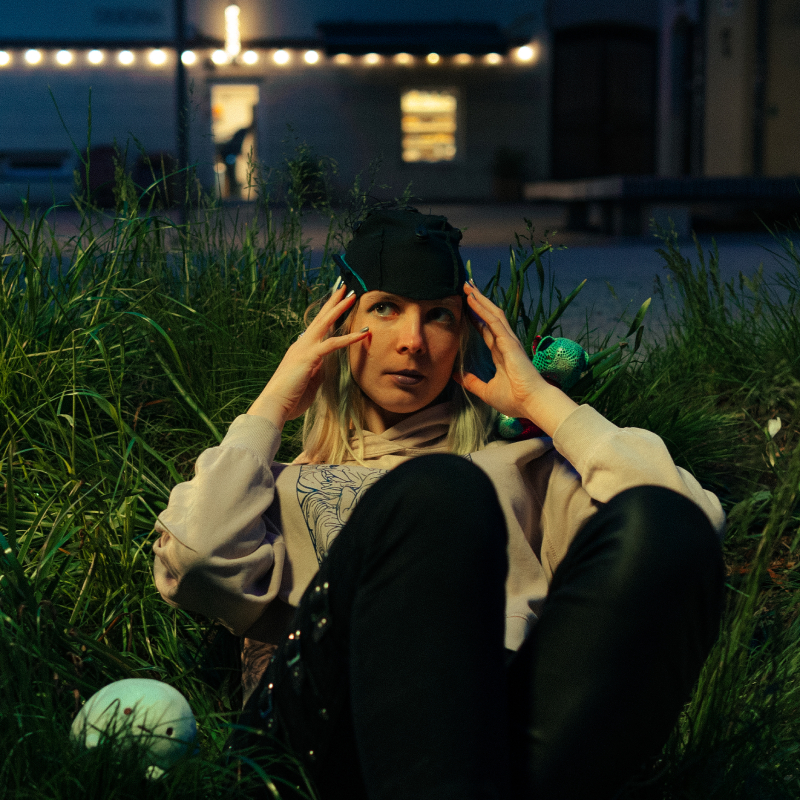
Professionally, I'm a lecturer and dream researcher, with a background in ML engineering and bioinformatics. I'm also a game developer and sci-fi writer.
Lecturer
From 2022, I am employed in two Vilnius universities as a lecturer.
I teach Bioinformatics, Python programming, and Mathematical models in Biology.
I am assistant lecturer of Adaptive Neurotechnologies, led by prof. Milena Korostenskaja, who is as warm as she is inspiring.
I also taught Natural Language Processing in 2024-2025, but transferred it to another lecturer to lower my teaching load.
I supervised several Bachelor and Master students.
Students choose me as a supervisor to move from wet lab to computer science.
Some topic examples:
-
Structure-Based Phylogenetic Tree Reconstruction for G Proteins and Small GTPases
Bachelor Thesis of Mariia Goman (2024) -
Predicting Enzyme Catalytic Activity with Computational Tools
Bachelor Thesis of Gustė Pažūsytė (2025) -
Predicting Dream-Related Emotion From EEG Data Using Deep Learning
Bachelor Thesis of Sofiya Asadchaya (2026)
Dream Researcher
I created the ReaDream project (and in the process of getting a related PhD position).My Master Thesis (2020-2022) was on dream decoding directly from human brain.
I created the topic myself, encouraged by my supervisor prof. Korostenskaja.
I came to it from a wet-lab background (my Bachelor was in Bioengineering), so this was my self-taught entry into brain and sleep data.
I decoded hand and tongue movements from ECoG data using a simple CNN written from scratch with PyTorch, and then tried to find similar patterns in sleep data.
The Thesis itself is published here.
It also resulted in a conference paper,
as well as a keynote speech at BCI & Neurotech Masterclass organized by g.tec in 2022.
There is also a podcast session on Neurocareers: Doing the Impossible!
I participated in several dream-related academic events.
- Lucid Dreaming Symposium in Bern (2025), with a poster co-authored with Ninon Lizé Masclef
- Dream x Engineering Symposium in Boston (2026), with a poster
- Neuroscience of Dreaming Summer School in Lucca (2026)
ML Engineer
My first job was sorting shoes by color.My first ~serious~ job was as a research assistant in BPTI in 2019. This is where I learned ML fundamentals and worked with my first datasets. I fell in love with the ML community, as it felt more open than the biological sciences.
First, I worked with bioinformatic data.
- My Bachelor Thesis topic was developing a deep learning model to predict the binding strength of a molecule to a target protein. Such models are useful in drug development.
- I did NGS analysis for a project on textile waste composting (papers: 1, 2).
- I was the bioengineer of the Algy team, developing an algae-based air purifier. The project won second place at Makeademy (2021) but halted due to the pandemic.
- I worked with image analysis & ML pipelines to predict a pig's weight from a photo. The project later won second place in Rethinking Hardware 2.0.
- I operated Structural Biology-related models such as AlphaFold and ProteinMPNN, working as a protein engineer in Biomatter.
Then, I moved to brain data specifically.
I participated in the BR41N.IO hackathon,
organized during the BCI & Neurotechnology Spring School.
During my second participation, my team won third place with the brain2music project,
which was my idea to transform brain waves into sound waves without heavy AI.
I was also affiliated with Fluid Interfaces (MIT Media Lab) on a project of decoding observed 3D shapes from human EEG signals (publication),
although I joined the project only at the very end of it.
Game Developer
When prioritizing university programs for my Bachelor degree, under Bioengineering (which I got into) I put Multimedia Technologies, because it was related to game development. Although I became a scientist, I always kept gamedev as an important hobby.I have both finished projects and grandiose plans.
Typing Tit : a minimalistic typing game with lyrics I made to learn the Godot engine. The code is public.Mour : a fast-paced card game about making combos (somewhat similar to Uno). I made the rules, designed and printed the cards, and someday plan to make it digital.Languale : sitting in the family of Wordle-like games, it's about guessing the English word from its translations to different languages. Currently in closed alpha.Cavedive : a minimalistic cave explorer I made to learn the Lua language (with LÖVE). Caves are randomly generated with my custom algorithm based on Poisson noise. Not yet public.Hand : a console-based surreal puzzle game where you start with only your hand in the void. Originally in Python, it was rewritten to JavaScript by Edvardas Dlugauskas and can be played here.Genfarm : an ongoing, ambitious attempt to simulate realistic evolution of biological organisms. Started in ~2023, it has since branched into several projects such as a genome editing simulator and procedural body generation from DNA sequences. Currently private.Villager : this is a placeholder name for a game about managing a post-apocalyptic village, focusing on law writing and recycling, with villagers having free will, characters, relationships, etc. Inspired by Rimworld, but without direct control over the villagers. Currently in early development and not public.
Sci-Fi Writer
I wrote my first book when I was 6 years old, and have kept writing ever since.My work was first published in 2016.
It was one of my tales included in Stupeni ("Steps"),
an international literary and journalistic almanac issued by the association of writers and publicists based in Vilnius.
I had my tales published in the 2017 and 2018 editions of this almanac as well.
My work also appears in the Anthology of Lithuanian Children's Literature,
a collection of around 85 authors marking the 150th anniversary of Mikalojus Konstantinas Čiurlionis.
All of these works are in Russian.
More recently, I wrote a book called Reality, which is a set of sci-fi tales. I plan to translate it into English and publish digitally.